
blog
A peek inside the brain of a movement-based physical therapist…
Injury prevention & management
Movement practices for longevity
Optimal performance and more…
Have questions or topics you’d like to see covered here?
Email me directly at brandon@orlandomovement.com
Orlando Movement Practice Origins - How A Night in the ER Led To Better Helping You Receive the Care You Deserve
Orlando Physical Therapy and Movement Training done differently…
Every day I’m eternally grateful to go to work, knowing I get to work with ideal clients who are active and care about their health.
It wasn’t always that way though…
If you have a few moments to get to know me a bit better, I’d love to share why I started Orlando Movement Practice as well as how I developed my approach to movement development and whole body restoration.
The Night I Felt Like I Was Dying
I remember that November night vividly... It was brutal. So brutal, in fact, that I ended up in the emergency room…
I had been ripped out of my sleep around 11pm with distinct symptoms of feeling like I was having a heart attack…pain in the left side of my chest that radiated down my left arm and a bit into my jaw, my heart beating furiously…
I was flush and could barely catch a breath. Even though I knew techniques to find calm in stressful scenarios, I could not control these feelings and was spiraling out of control.
My wife tried to ease my worry, but we decided to head to the emergency room and after 4 hours of tests, the results?
Stress.
“You’ve got to be kidding me!” I thought to myself. How embarrassing. How did I let myself get to this point?
My Background Story
When I started my career as a physical therapist, I worked for one of the large hospital systems with clinics all over the place seeing upwards of 20 patients each day. In a few short years I had accumulated a few thousand patient care hours across multiple age groups, ethnicities, conditions, and starting levels from sedentary couch potatoes to elite level athletes.
I was accustomed to adapting to high stress scenarios though, so I thought nothing of it for awhile, until my body started showing signs that things were not all right.
See, my whole life I have been a survivor. Several tough experiences growing up led to constant low levels of anxiety and I was good at hiding it. No one would've known.
Couple that with an extremely technical mind, a really genuine desire to help people with my skillset, and unrelenting demands for productivity instead patient care, and it was a crash waiting to happen.
Our Healthcare System Is Broken and Failing Everyone Involved
In my job I had to make a daily decision to sacrifice myself or the quality of care of my patients and I fell on the sword nine times out of ten. I had seen so many PTs become complacent and burnt out because of this system, but I was determined not to let that be me.
After a few years, I was spending up to 3 hours each night catching up on paperwork because I made the choice to hone my craft and help my patients over getting home at a decent hour.
My life was minimized and that became unsustainable. After that scare with my heart, I had to get out.
I was tired of it all, so I broke away…
My Biggest Influences In Movement
Over time, my unique approach to human movement development and restoration emerged out of engaging in endless hours of continuous personal research outside of my formal doctoral level education to merge ancient wisdom with current findings in the literature. On top of that, I was working through an extensive personal injury list myself, trying to apply the things I was learning to restore some youthfulness to my body.
I’m a technician who pays extreme attention to detail.
I’ve come to be influenced by rehabilitation industry pioneers like Kelly Starrett of MobilityWOD, Gray Cook of Functional Movement Systems, Andreo Spina of Functional Range Conditioning and others as well as eclectic and controversial movement teachers like Ido Portal of Ido Portal Method and Erwan LeCorre of MovNat. If you don’t know these guys, check them out!
By drawing on numerous movement disciplines like martial arts and parkour on top of a diverse lifting and athletic background I can extract commonalities in human movement that link all these disciplines together more than you might think and thereby help a wide range of clientele.
Personally, I grew up as an athlete ever since I could walk. My main sports were soccer, basketball, and volleyball, and I played everything else in between with the neighborhood kids for fun.
As most athletes have experienced, I had my fair share of injuries…multiple ankle sprains leading later to ankle impingement, reoccurring breath-taking back pain with tingling into my right foot, hip impingement, knee sprains and meniscus tears, shoulder impingement and rotator cuff injuries, wrist injuries, plantar fasciitis, stiff and achy muscles and joints…
It was rough at times. I recovered from all, but they all came back in varying degrees...that is, until I figured out how to take care of my body differently.
It took roughly 20 years of tinkering to come to the process I use now that has not only helped me regain the youth of my joints (in fact, I feel more mobile and strong than I was in high school!), but has also helped rebuild a few world champions and help many that were caught in relentless cycles of chronic or acute pain and injury.
That’s how Orlando Movement Practice was born...
I was frustrated with seeing patients come back to the clinic for the same issue because their insurance had put restrictions on how we could care for them, reimbursement was terrible, and most of the PTs had gotten burnt out. The reality is that this broken system forced us to see up to 4 people in one hour just to stay productive and quality suffered as a result.
You deserve better than that.
While most clinics give cookie cutter “best evidence-based exercises” for back pain or knee pain with little-to-no individualization offered, I share a straight-forward process to restore and rebuild the body based on the whole person in front of me.
What's even more awesome, is I'm still on that same journey with you and will be for the rest of my life.
With that said, I can’t wait to share that process with you!
I hope you'll join me for one of my upcoming Community Movement Classes or come see me in person if you're looking for some specific help and guidance.
Dr. Brandon
P.S. Feel free to reach out via text or call at 407-900-8721 or email brandon@orlandomovement.com. I respond personally to every message I receive!

How to Figure Out the Root Cause of Your Pain Or Stiffness
Have you heard of the Regional Interdependence Model?
No? Most people haven’t, but it radically changes the way you look at the body and helps to simply the process behind eliminated aches, pains, and stiffness.
Let’s take a look at some examples…
Have you heard of the Regional Interdependence Model?
No? Most people haven’t, but it radically changes the way you look at the body and helps to simply the process behind eliminated aches, pains, and stiffness.
Let’s take a look at some examples…
Do any of these real life scenarios sound like you?
Middle-age male, active in CrossFit, who had been stretching his shoulders for 2 years and his overhead position still hadn't improved.
Female waitress in mid 20s, active with weightlifting and running, who had knee pain for a year and a half and didn't get better with months of physical therapy.
Female pro waterskier, early 30s with chronic back pain told to strengthen her hips, back and core, but had only short-term results that left her unable to ski and ready to retire because of it.
These are all real cases. All of them got better or saw significant improvements* in 3 sessions or less as a result of a lens I use in my screens called The Regional Interdependence Model.*NOTE: Significant improvement does not mean FIX, it just means feeling better than before. Especially for those in chronic pain, it took 1-6 months of consistent work and application of the process I laid out for them for them to rebuild their foundation. Then real progress was rapid.

Mobile Areas: Ankles, Hips, Thoracic Spine, Upper Neck, Shoulders, Wrists; Stable Areas: Big Toes, Knees, Low Back, Shoulder Blades, Lower Neck, Elbows
In a really simple sense, this model states that you cannot isolate one region of the body from another.
Try this...Grab the right shoulder area of your t'shirt with your right hand, then grab the left lower part of your shirt near your left hip. Keep your right hand in place and pull down on your shirt with your left hand. You'll see a line of tension appear between your two hands.
The body works exactly the same way via connected lines of soft tissue (muscle, fascia, ligaments, connective tissue, etc).
In the case of someone with shoulder pain, this offers a clear picture as to how it is a completely viable explanation that limitations in the LEFT hip could cause excess tension and potential pain in the RIGHT shoulder. *
*Though this is definitely plausible and I’ve seen the hip affect the shoulder numerous times, 9/10 shoulder issues usually lie in limitations in the thoracic spine (your mid-back) causing reactions in the shoulder blades and shoulder itself
This is really powerful, because it makes it really easy to see how those 3 cases listed above could have gone misdiagnosed for all those years.
Let's break this Regional Interdependence Model down a bit further.
Every major joint in your body is designed for one of two primary purposes: mobility or stability (interchangeable with stiffness in some cases)
From feet to head we see the pattern clearly in alternating fashion demonstrated in the image to the above...
When one of those areas takes on the opposite role (i.e. t'spine becomes stiff) the areas above and/or below take on the opposite role as well (i.e. low back and low neck become more mobile)
But mobility is good, right? Not when that's away from the original design...
If the low back and neck are supposed to be stable, they're going to get more motion and more wear and tear than they should because they will hit their barriers sooner than they should to compensate for the stiff t'spine.
Similarly, I have NEVER seen a bum knee that didn't result from limitations (not pain) in the hip and/or ankle.
Here's another metaphor. Say you're in a fight. Your opponent punches you in the face. Your face is going to hurt. His hand is not going to hurt (or at least not as much).
With back and neck pain, your stiff t'spine is placing a beatdown on your back and neck (or shoulder, remember!) and they're the ones shouting in pain to stop the beating.
HINT: If you currently have back AND neck pain right now, 99.9% positive it's going to come from limitations in your t'spine.
Make sense?
So, the common sense way to fix ALL musculoskeletal issues is to simply bring the major joints back to their original design.
How do you do bring the major joints back to their original design?
On your own...learn your limits and weak points.
Then, tailor your training towards ironing those things out as priority number one. Stiff? Attack it! Left vs. Right side differences? Do your best to iron them out with single leg or single arm or one-sided rotational movements. Always aim for symmetry, even if you will never fully attain it.
Want the faster track? Get assessed.
A skilled physical therapist can help you learn where your limitations are and attack them so you don't have to keep guessing. If you have laser focus on those areas, can get equipped with the right tools to attack them, you can develop a crystal clear strategy and see massive improvements that move you in a consistently forward direction.
Bringing it back to the cases from above:
1. The CrossFitter's shoulder issues were a result of a stiff t'spine which didn't allow his shoulder blades to remain stable and allow his shoulders to function like shoulders should. Stretching his shoulders was causing more issues, but they began opening up with his overhead position improving consistently with work toward t'spine mobility. 2 years wasted stretching the wrong parts. Now muscle-ups were in the cards.
.
2. No results from traditional models for knee pain? It was because she had a sacroiliac joint dysfunction (a muscular imbalance across her pelvis and hips) altering the tracking of her hip, altering the tracking of her knee along with significantly limited ankle dorsiflexion, causing compensations and excess work at the knee. Better in one session, pain-free in 3 (remember...not FIXED..just feeling better for the first time in awhile. She's still working on those stubborn ankles, which can take 2-5 years to permanently open up if I'm being honest). One and a half years she spent not knowing how to fix it and not knowing that it was fixable.
3. Pro waterskier with chronic back pain...t'spine as stiff as a brick wall, and hip flexors so tight they were locking the knee and the back down (oh I forgot to mention...she had a history of meniscus tears and ligamentous injuries in her knees...all related issues under this lens). She feeling better in one visit, again pain-free in 3, and continues working with me while consistently placing top 3 in all major tournaments around the world. And she was seriously considering that it was time to retire!
PLEASE NOTE: I'm not saying I get these results are the kinds I get with everyone, but they are just some examples of people that got lost in the system and I was able to provide a different lens and a process to find their way back to freedom.
Friends...you don't have to live with pain. If you don't have pain, you can unlock a lot of things that seem unattainable with this kind of laser focus on your body and prevent major issues in the future.
If you're in the Winter Park, FL or Orlando, FL areas and want some help I'd be happy to meet you and see if we're a good fit to work together.
Shoot me a text or call to 407-900-8721 or email brandon@orlandomovement.com if you have any questions or would like some insight on how this model might apply to your specific situation.
Happy moving!
Dr. Brandon
How Physical Therapy Can Benefit You...Even If You're Not In Pain (PLUS 3 Things You Might Not Have Known About PT)
Are you working through back pain or knee pain, other joint stiffness, or some sort of sports injury?
Have you been exercising for years and feel like you keep hitting plateaus and you're not sure how to break through?
Were you never taught how to take care of your joints so you can recover better as an athlete or prevent arthritis from occurring or progressing as an aging human?
Does learning strategies to bulletproof your body for life or sport sound like it may benefit you?
Then, Physical Therapy* might be for you!
Do any of the following sound like you?
Are you working through back pain or knee pain, other joint stiffness, or some sort of sports injury?
Have you been exercising for years and feel like you keep hitting plateaus and you're not sure how to break through?
Were you never taught how to take care of your joints so you can recover better as an athlete or prevent arthritis from occurring or progressing as an aging human?
Does learning strategies to bulletproof your body for life or sport sound like it may benefit you?
Then, Physical Therapy* might be for you!
*or physiotherapy if you're of a more global mindset and want to sound cooler (I do!)
Maybe you're not sure what physical therapy does or if it can help.
Maybe you've even tried just about every orlando physical therapist for your neck and shoulder pain and it didn't work so you don't think it can.
Maybe you're skeptical and think surgery and/or painkillers are the only option for your back pain, and maybe even your physician told you that.
Maybe you're working through some painful or stiff joints and you've been told to stop running or CrossFitting. That was probably not the answer you were looking for, but you just accepted it because...well...your doctor told you so).
Perhaps you don't know that there are much better and faster ways to gain mobility and relieve stiffness than traditional static stretching and that sometimes you can hit PRs and nail goals WAY more easily as a result of having better positioning and mechanics to perform the activities you're just being told to stop doing.
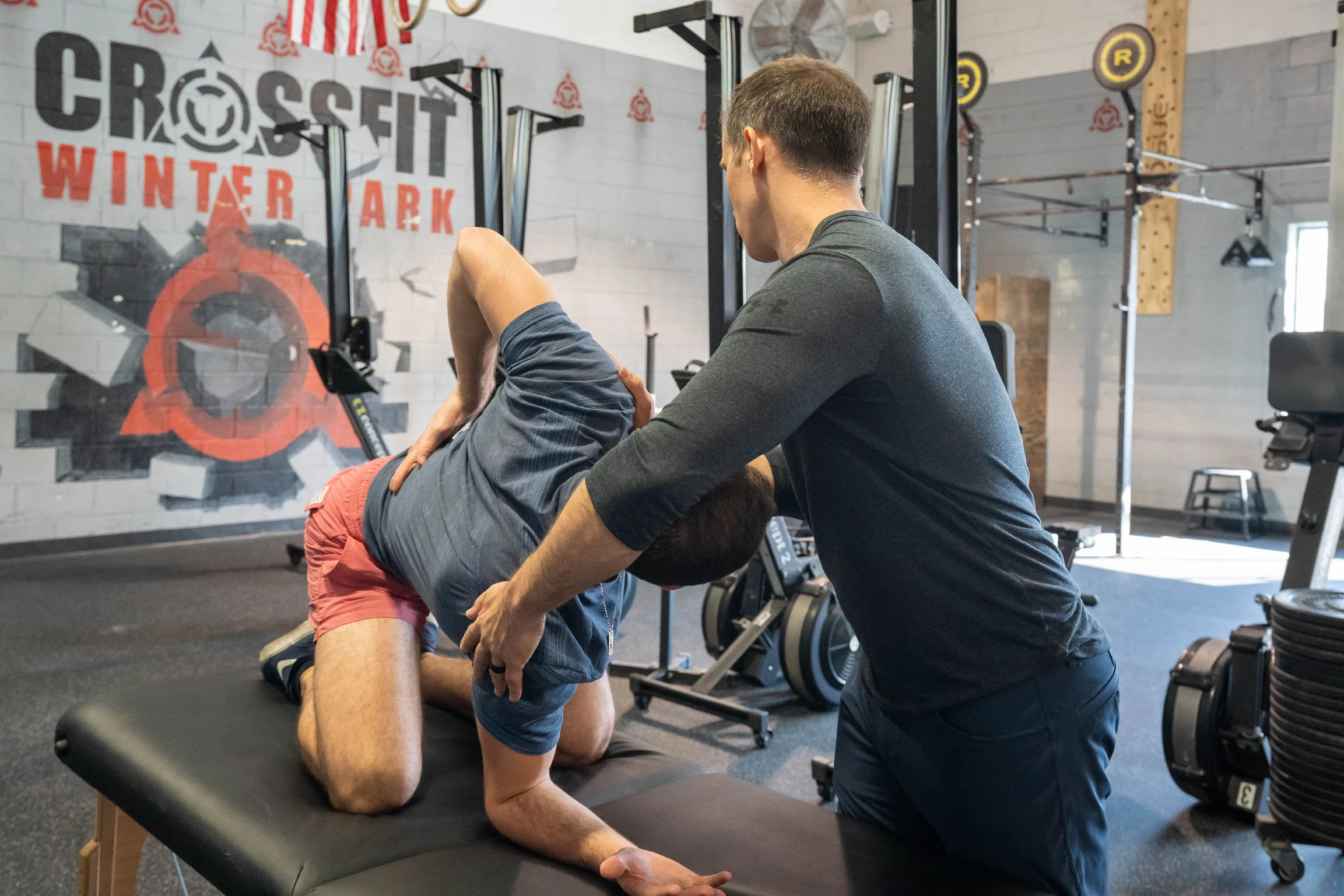
Whatever your story is, as a movement specialist and Doctor of Physical Therapy, I can help you find more physical freedom to do what you love to do.
Here are some things you might not know about physical therapy and what a physiotherapist can do:
1. You can see a physical therapist directly, without having to see your physician first
These rules vary by state, but in the state of Florida, where I practice out of the cities of Winter Park and Orlando, you can go directly to a PT (direct access) for 30 days before requiring a physician to sign off on my plan of care.
Even less restrictive, if you've EVER been seen by a physician for any issue with which you want help, then I can see you for the rest of your life if you really want...
In fact, many of my clients keep training with me on some level because I get them out of pain, but I'm also experienced as a movement teacher and trainer, so I can help them completely fix the issue and then work on performing better in their sport or achieving their health and fitness goals.
2. A physiotherapist is trained in differential diagnosis (what?)
This is a fancy term that means it's more cost effective to come see me first, because my knowledge base allows me to be able to know when you'll benefit from my services without painkillers, injections, surgeries, etc... OR when you really do need to go see a physician.
I can screen for red flag symptoms such as nausea, vomiting, recent rapid weight gain/loss without trying, night sweats, fevers, chills, general malaise (ill feeling) that may indicate something more serious than just muscle or joint aches and pains.
I can also recognize red flags (though I cannot write a script for imaging or make a diagnosis from it) on most imaging that would warrant further treatment or diagnosis by a physician.
This does NOT mean I'm trying to replace a physician, it means I'm different and I believe 95% of orthopedic issues can be solved without seeing your physician.
This actually benefits the physician as well because it means they don't have to waste THEIR time seeing movement related issues and can better use their time helping those that really need their knowledge and expertise.
What's more...most physicians don't know that much about exercise or nutrition because it is very very small portion of their training, so they're really not the most qualified to give advice on those topics unless they've done their own personal research.
A physical therapist is an EXPERT on all things movement and exercise, from zero-to-hero levels.
NOTE: Not all PTs are created the same.
Find a PT that is familiar with your sport or activity and has experience as both a trainer/movement teacher/coach AND as a rehabilitation professional.
Most don't know that Physical Therapists rank 2nd highest in knowledge of anatomy and how the body works, only under Orthopedic surgeons, who tend to be very specialized in their area of expertise.
3. A Physical Therapist can help a myriad of conditions, both simple and complex
Here are just a few of the conditions a PT can help:
Back pain, sciatica, degenerative disc disease, disc herniations, scoliosis, SI joint dysfunction, hip pain, trochanteric bursitis, femoral-acetabular impingement (hip impingement), knee pain, patellar tendinitis, runner's knee, jumper's knee, chondromalacia patella, meniscus tears, MCL / ACL / LCL sprains and tears, osteoarthritis of any joint, ankle sprains, achilles tendonitis, peroneal tendonitis, plantar fasciitis, turf toe, neck pain, cervical disc displacement, tension headaches, shoulder pain, rotator cuff tears or tendonitis, shoulder impingement, shoulder labral tears, carpal tunnel syndrome, wrist pain, golfer's elbow (medial epicondylitis), tennis elbow (lateral epicondylitis), sports injuries, all forms of muscle/tendon/ligament injuries, general lack of flexibility/mobility, postural corrections, and more...
If you have any of those conditions, don't wait to reach out and get help. You don't have to live with that pain or feel limited in your ability to hit your goals.
If you're looking for relief or a leg up on your competition, don't hesitate to reach out.
Ask any questions by calling 407-900-8721 or email brandon@orlandomovement.com and I'll get back to you.
If you need or want help NOW, you're in the Central Florida area and can make it to Winter Park, FL, fill out the super quick form below with some brief information and I’ll get back to you within 24 hours M-F.
Dr. Brandon